
Guides · Mon 16 Nov 2026
Beppu and Yufuin: the onsen weekend from Fukuoka
Two onsen towns, an hour apart in Oita prefecture, make the natural weekend out of Fukuoka. Yufuin is the quiet one, a lake, a shopping street and Mount Yufu over everything. Beppu is the loud one, a steaming city of some 2,800 hot spring sources, seven coloured hells you look at rather than bathe in, sand baths and steam cooking. How to pair them in two days, in which order, and how to bathe properly when you get there.
Fukuoka is a fine city to spend a weekend in, and our Fukuoka weekend guide makes that case in full. But the best weekend from Fukuoka leaves the city altogether. Two hours east, in Oita prefecture, sit the two most famous onsen towns in Kyushu, and they could hardly be less alike. Yufuin is small, rural and composed, a single pleasant street running to a misty lake under a twin peaked mountain. Beppu is a working city that steams at the seams, with more hot water coming out of the ground than anywhere else in Japan and a sightseeing circuit built around springs so hot and so coloured that they are called hells. An hour joins them. Together they are a complete weekend: one day to slow down, one day to stare at geology, and a proper bath at the end of both.
Getting there from Fukuoka
Both towns have direct limited express trains from Hakata Station, and choosing which town to visit first decides which train you want. For Yufuin, the train is part of the trip: the Yufuin no Mori, JR Kyushu's green sightseeing limited express, runs from Hakata to Yufuin in about two hours and fifteen minutes. Every seat is reserved, the train runs only a few times a day, and on weekends it can sell out well ahead, so book it the day you fix your dates rather than the day you travel. One of its daily runs continues beyond Yufuin to Oita and Beppu. For Beppu first, take the Sonic limited express instead: frequent, direct, and as fast as two hours and one minute from Hakata to Beppu Station, at ¥6,380 (about US$42) for an unreserved seat or ¥6,910 (about US$45) reserved. Between the two towns, allow about an hour by bus or by the rail route through the valley. Coming home, the Sonic from Beppu to Hakata runs through the evening, which is what makes a Sunday in Beppu workable without watching the clock from lunchtime.
Saturday: Yufuin, the slow day
Arrive in Yufuin late morning and do what the town is arranged for: one long, unhurried walk. From the station, with the tourist information centre beside it, the road runs straight towards Mount Yufu, and after about ten minutes becomes Yunotsubo Kaido, the main street. For roughly 800 metres it is lined with sweet shops, craft and glass shops, cafes and snack stalls, some seventy places in all, and it asks very little of you except grazing. Eat as you go. The street ends, after about half an hour of walking from the station if you could ever resist stopping, at Lake Kinrin.
The lake is the point of Yufuin. Cold stream water and hot spring water both rise into it, which keeps it warm enough to steam on cold mornings, when mist sits on the surface and the whole scene lives up to the postcards. Its name means golden scale lake, for the way the light catches the fish. Walk the path around the shore, look back for the classic view of Mount Yufu over the water, and take the quieter lanes along the river on the way back into town rather than retracing the shopping street at its busiest. Then bathe. Yufuin's ryokan open their baths to day visitors in the afternoon in many cases, and the town has small public baths as well. This is the gentlest possible introduction to Japanese bathing before Beppu raises the stakes tomorrow, and the etiquette section below is worth reading before your first bath of the weekend, not after it.
Stay the night in Yufuin if you can. The town changes completely once the day buses leave: the street empties, the lake mist comes back, and dinner at a ryokan followed by an empty outdoor bath under Mount Yufu is the single best evening this weekend offers. If your nights are spoken for, the alternative shape is to move on to Beppu in the late afternoon and sleep there instead, which buys you an early start on the hells.
Sunday: Beppu and the seven hells
Beppu announces itself before you see anything: columns of steam rise all over the city, from vents, roofs and drains, because the ground here is barely containing itself. The city counts some 2,800 hot spring sources, the most in Japan, spread across eight old onsen districts collectively called the Beppu Hatto. You are not going to bathe in the famous ones, though. The seven hells, the jigoku, are springs for looking at, at temperatures up to about 99 degrees, and they have been a sightseeing circuit for long enough to have it down to a system.
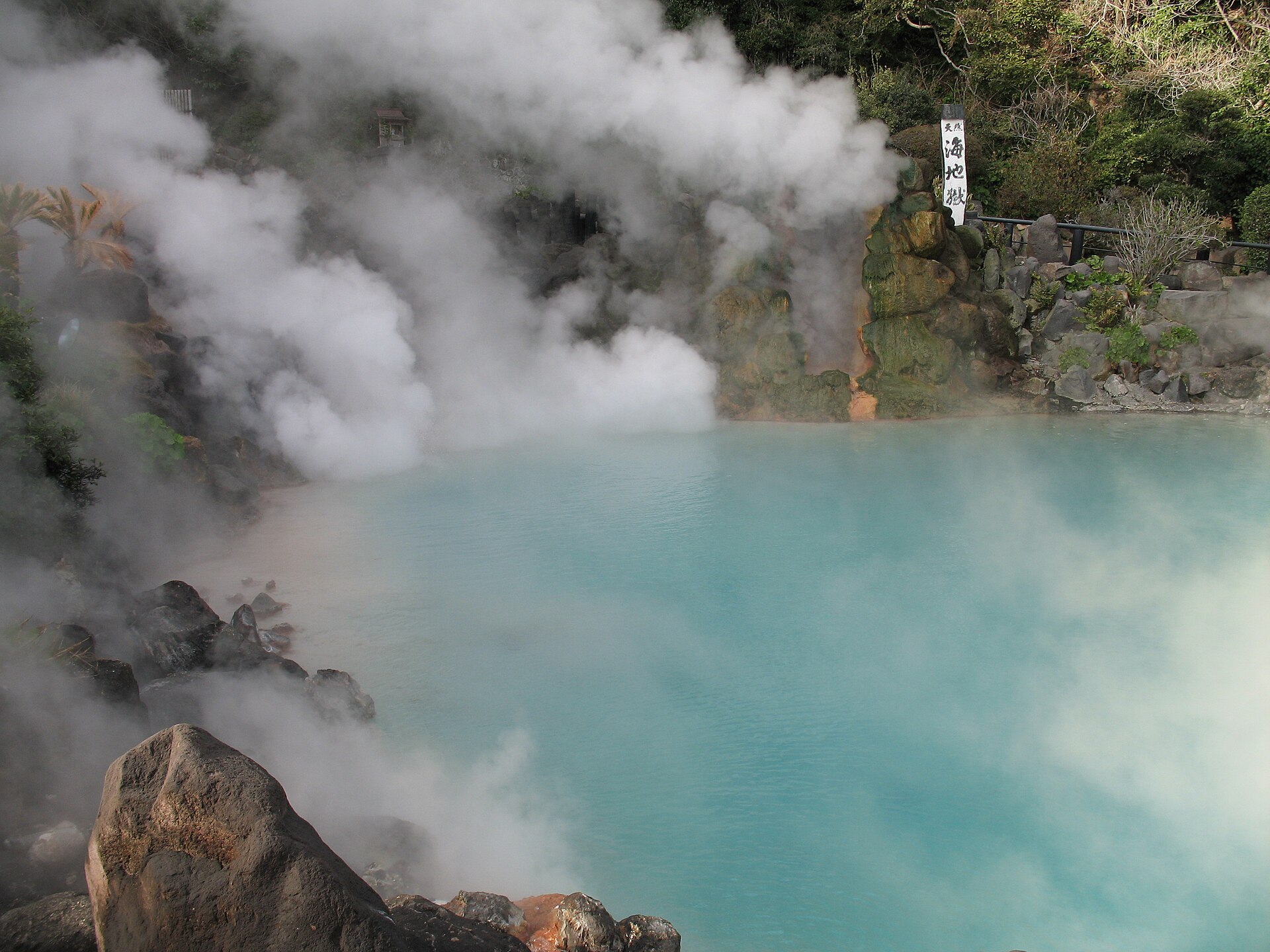
Five hells sit together in the Kannawa district, a bus ride of about twenty minutes from Beppu Station, and can be walked between. Start at Umi Jigoku, the Sea Hell, the largest of the seven: a deep cobalt blue pond at about 98 degrees, coloured by iron sulfate, steaming under its garden, with a foot bath where your feet are allowed in the water even if nothing else is. Then work through its neighbours. Oniishibozu Jigoku bubbles grey mud in round domes said to look like the shaved heads of monks. Kamado Jigoku, the cooking pot hell, is the playful one, with ponds of several colours, steam to inhale, foot baths and snacks cooked in the heat. Oniyama Jigoku keeps crocodiles in its warm pools, which is either a highlight or a reason to walk faster, and Shiraike Jigoku is the calm one, a milky white pond in a Japanese garden. The last two hells sit a short bus ride away in the Kamegawa area: Chinoike Jigoku, the blood pond, a startling natural red and the oldest of the hells, and Tatsumaki Jigoku, a geyser that performs on its own schedule, roughly every half an hour or so, whether you are ready or not.
The tickets are simple. One hell costs ¥500 (about US$3). The common admission pass covering all seven costs ¥2,400 (about US$16) for an adult, is sold at any hell entrance, and stays valid on the day you buy it and the day after, which suits this weekend perfectly if you arrived on Saturday evening. All seven open from 8am to 5pm, every day. Give the full circuit two and a half to three hours at a civilised pace, and eat in Kannawa while you are there: jigoku mushi, hell steaming, is the local cooking method, vegetables, eggs, seafood and buns steamed over the same fierce heat you have been photographing all morning. The Jigoku Mushi Kobo workshop in Kannawa lets you steam your own lunch, which is the most fun a cooking class can legally have.
Bathing in Beppu, and how to do it properly
Sightseeing done, the afternoon is for getting in the water at last, and Beppu's range of baths has no equal in Japan. In Kannawa, Hyotan Onsen is the big, welcoming day bath complex, open from morning until 1am, with indoor and outdoor baths, a waterfall bath and its own sand bath. Kannawa also keeps its historic steam bath, where you lie on a bed of aromatic herbs in a stone chamber filled with spring steam for about ten minutes. Near the station, Takegawara Onsen, in a striking building dating to 1938, is the classic address for a sand bath: you lie down in a yukata and an attendant buries you in hot spring heated sand for around ten minutes, after which you rinse off and take the ordinary, very hot, bath. However you bathe, the manners are the same everywhere in Japan, and they are simple. Undress completely in the changing room; communal baths are taken naked, and almost all are separated by sex. Wash your whole body thoroughly at the seated shower stations, and rinse all the soap off, before you go near the bath. The water is for soaking, not washing. Keep your small towel out of the water, folded on your head or left at the side, tie long hair up, lower yourself in slowly, and keep the volume down. Tattoo policies vary from bath to bath in Beppu, and the city publishes a list of tattoo friendly facilities, so check your chosen bath before you go rather than at the door. Short soaks, water between baths, and no heroics in the hottest pool will leave you feeling better than you arrived, which is the entire point.
The organised option, and where to sleep
If two towns, three trains and a bus network sounds like one timetable too many, the day trip that strings Yufuin and Beppu together from Fukuoka handles the driving and the order of the day for you. It covers Yufuin's streets and Beppu's Kamado Jigoku, then splits between a brewery route and Dazaifu Tenmangu on the way back, so choose at booking. It is a long day and it is not a weekend, but as a taste of Oita in a single day it is honestly hard to beat.
Book the Yufuin, Beppu and Dazaifu day tripvia Viator · affiliate link
For the weekend itself, sleep where the baths are. In Beppu, stay in Kannawa if the hells and the steam are the draw, or near Beppu Station if you want the widest choice of places to eat and an easy train home.
Stay in Beppuvia Trip.com · affiliate link
And if the weekend is really a long Fukuoka trip with an onsen escape inside it, bookend it in the city, in Hakata for the early trains this guide depends on.
Stay in Fukuokavia Trip.com · affiliate link
One city of steam, one village under a mountain, and two baths a day. Fukuoka will still be there on Sunday night, and it will feel, briefly, like the quiet one. Our Dazaifu day trip guide covers the other great day out from the city, and the Fukuoka attractions page holds the full list back at base.
More reading on the articles page, or go straight to the events calendar.
Noteworthy events direct to your inbox.
Get what’s noteworthy for the weekend and beyond every Wednesday in your inbox.