
Guides · Wed 11 Nov 2026
Dazaifu in a day: Tenmangu, the Kyushu National Museum and the Himiko exhibition
Dazaifu, thirty minutes from Fukuoka, pairs the shrine of the god of learning with one of Japan's four national museums, and the museum's Himiko and Her Mirrors exhibition, on the shaman queen and the bronze mirrors behind the first Japanese kingship, runs to Monday 11 January 2027. The day, in the order to walk it, with the museum's December closures flagged before they can catch you out.
Dazaifu was Kyushu's seat of government more than a thousand years ago, the office that dealt with the continent, and it still carries itself like a small capital that retired into religion and learning. Two institutions hold it up. Dazaifu Tenmangu, the shrine built over the grave of Sugawara no Michizane, the scholar exiled here from Kyoto in 901 and deified after his death in 903 as Tenjin, god of learning, draws students in their exam season thousands to pray for results. Five minutes up the hill behind it, the Kyushu National Museum, one of only four national museums in Japan, tells the longer story, of Japan made through exchange with Asia. Between them they make the strongest day trip in Fukuoka prefecture, and this winter the museum holds the exhibition that ties the whole island's deep past together.
Morning: the shrine first
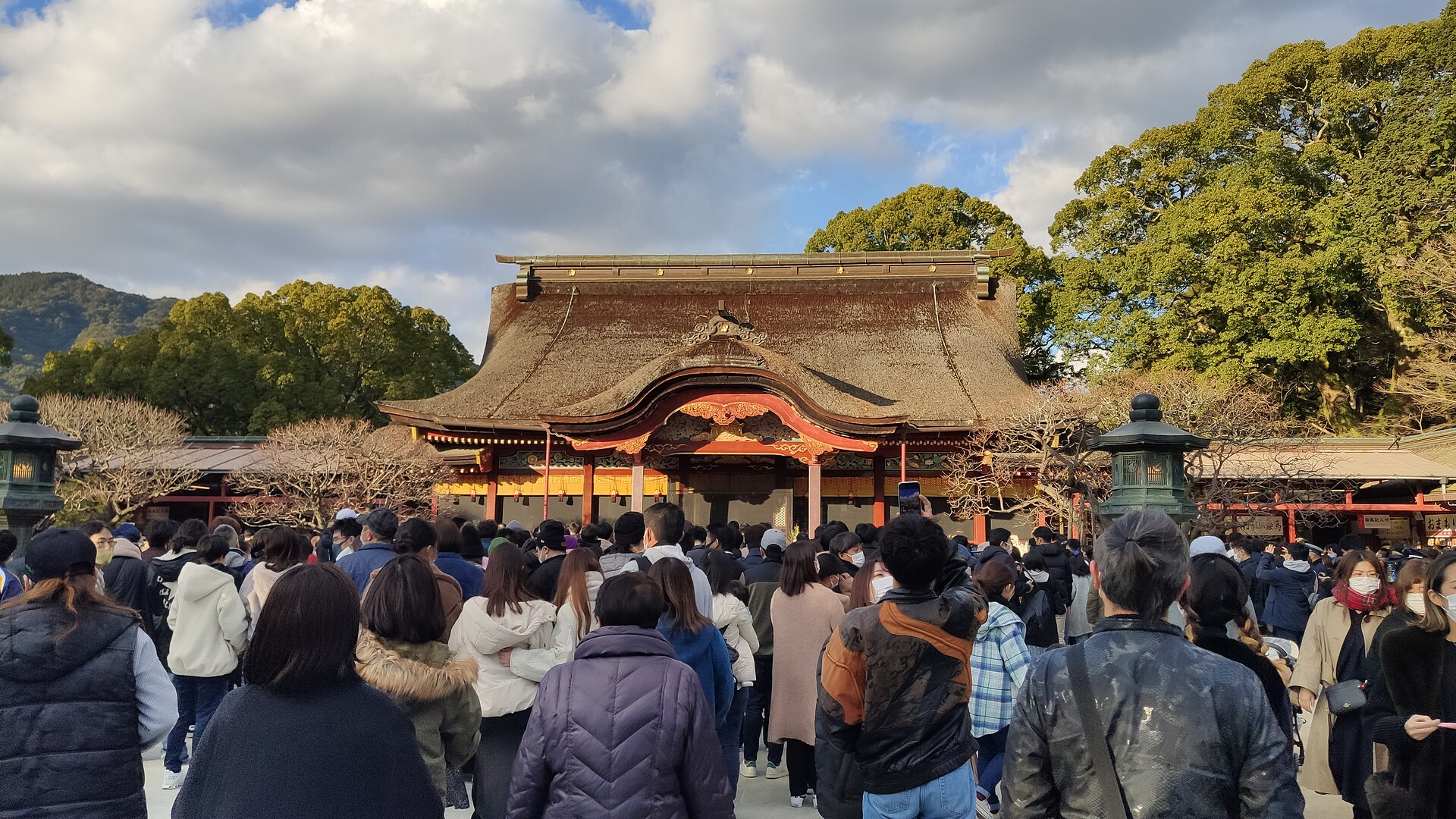
Go early, and go to the shrine before the museum, because the approach is half the pleasure and it fills by midday. From Dazaifu Station the sando, the shrine approach street, runs a few minutes to the gates, lined with shops grilling umegae mochi, the sweet rice cakes stamped with a plum crest and eaten warm from the iron. Buy one. Everyone does, and the plum is not decoration: Michizane loved plum trees, the shrine's grounds hold some 6,000 of them, and its most famous, the Tobiume, the flying plum said to have flown from Kyoto to be with him, stands beside the main hall.
The grounds reward a slow circuit. Cross the Taiko bridges over the Shinji ike pond, arched spans read as past, present and future, pause at the bronze ox statues, rubbed bright by generations of students hoping some of the scholar's cleverness transfers, and then stand in front of the main hall, a Momoyama era building of lacquer and cypress bark that is an Important Cultural Property. The shrine has been carrying out the first major restoration of that hall in 124 years, with a temporary hall serving worshippers during the works, so check which face the shrine presents on the day you go; the grounds, the plum trees and the treasure house are the visit either way. Admission to the grounds is free, and the correct etiquette is the usual one: bow at the gate, keep to the side of the approach, and join the queue at the hall without any sense that you are intruding. Students praying before exams are not a spectacle. They are the shrine working as intended.
Midday: the museum, and Himiko
Walk up the hill, through the escalator tunnel the locals treat as a minor attraction in itself, to the Kyushu National Museum. The permanent Cultural Exchange Exhibition is the museum's argument in object form, Japanese history told through what arrived from the continent and what Japan made of it, and it earns an hour on its own. This winter it is the special exhibition that justifies the trip on its own.
Himiko and Her Mirrors: The Making of a Kingdom runs from 31 October 2026 to Monday 11 January 2027. Himiko, the shaman queen of Wa in the third century, appears in Chinese chronicles as the ruler who unified a fractious land and received, in 239, a gift of one hundred bronze mirrors from the Wei court. The exhibition assembles the mirrors, the triangular rimmed mirrors decorated with deities and beasts that Japanese archaeology keeps pulling from great tombs, and asks what they were for: diplomatic gifts, sacred objects, or the working machinery of a new kingship, the Yamato order that followed her. It is the rare blockbuster that is also an argument, built on current research, and for anyone whose Japan trip runs on history rather than shopping it is the exhibition of the winter in Kyushu.
The practical warnings matter, because the calendar is against the casual visitor. The museum closes on Mondays, with two exceptions, Monday 23 November and the final day, Monday 11 January, when it opens for the holiday. It also closes from Thursday 24 December to Thursday 31 December, so the Christmas week trip that works for almost everything else in Fukuoka does not work here. On Saturdays the museum stays open to 7pm under its Kyuhaku After Five hours, last entry at 6.30pm, against a usual 5pm close and 4.30pm last entry. Aim for a Saturday if your Fukuoka weekend allows it: shrine in the morning, exhibition in the long afternoon, and no Monday or Christmas closure anywhere near you. In the final days the hatsumode crowds at the shrine and the exhibition's last weekend will land on top of each other, so an early start in that first week of January is not a suggestion, it is the plan.
If you have time left
Two quieter stops complete the town. Komyozenji, the Zen temple just behind the shrine, keeps stone gardens that make a still counterpoint to the sando's bustle. Further out, the ruins of the Dazaifu government office itself, a broad field of foundation stones where the continent facing administration stood, give the day its scale: the shrine and museum are what grew from this field. Then walk back down the sando slowly, because the second umegae mochi tastes different from the first, and be on a train back to the city by the time the yatai stalls are setting up in Nakasu.
Doing it the simple way, and getting there
Under your own steam, Dazaifu is an easy navigation: Nishitetsu trains from Tenjin in central Fukuoka reach Dazaifu in about thirty minutes, usually with a change at Futsukaichi, and the shrine is a short walk from the station. From Hakata, allow a little longer. The alternative, for travellers who want Dazaifu folded into a bigger Kyushu day without working the timetables, is the day trip that strings the onsen towns and the shrine together: Yufuin's lake town streets, Beppu's steaming jigoku ponds, and a choice of routes that includes Dazaifu Tenmangu, with the driving and the order of the day handled for you. Choose the Dazaifu option when you book, because the same tour splits at that point.
Book the Yufuin, Beppu and Dazaifu day tripvia Viator · affiliate link
Sleep in Fukuoka, in Hakata for the station and the early train or in Tenjin for the evening, and treat Dazaifu as what it is: a day out from a city base, not a place that needs its own hotel night.
Stay in Fukuokavia Trip.com · affiliate link
Our Fukuoka weekend guide places Dazaifu in the city's wider weekend, the site's December anchor carries the month around it, and the Fukuoka attractions page holds the full list. One day, one shrine, one queen, one hundred mirrors. Go before 11 January.
More reading on the articles page, or go straight to the events calendar.
Noteworthy events direct to your inbox.
Get what’s noteworthy for the weekend and beyond every Wednesday in your inbox.