Guides · Mon 16 Nov 2026
Hakone in a day from Tokyo: the loop, the lake and the mountain railway
Hakone is Tokyo's classic day out because it is not one sight but a circuit: a switchback mountain railway, a cable car, a ropeway over a steaming volcanic valley, a pirate ship across a caldera lake, and a bus home, all covered by one pass. The day, in the order to ride it, with the one decision that makes or breaks it, the Open Air Museum, and an honest account of your chances of seeing Mount Fuji.
Tokyo has many day trips, but only one that is a machine for sightseeing. Hakone, in the mountains of western Kanagawa about an hour and a half from Shinjuku, arranges its attractions along a single circular route and then sells you one pass that covers every moving part of it. You climb by mountain railway, cable car and ropeway, cross a volcanic valley that steams and smells of sulfur, descend to a lake, sail across it on a ship built to look like a pirate galleon, and ride a bus back to where you started. Nothing on the route is the best of its kind in Japan, and the whole is better than anywhere else manages in a single day. This is how to do it well, in the direction that works, with the trade offs stated plainly.
First, the honest part: Mount Fuji may not appear
Every photograph that sells Hakone has Mount Fuji in it, across the lake or over the ropeway, and every one of those photographs was taken on a good day. Fuji makes its own weather and hides behind cloud for much of the year, and no viewpoint, ticket or start time can promise it. What you can do is load the odds. The mountain shows most often in the cold months, from November to February, when the air is dry and the snow cap is on, and it shows most often early in the morning, before cloud builds over the ridges as the day warms. A mid November day trip, like the one this guide is written for, is about as well timed as a day trip gets, and it still might give you a beautiful lake, a dramatic valley and no mountain at all. Go for the loop, which delivers in any weather, and treat Fuji as a bonus that sometimes turns a good day into the photograph. Check the forecast and the operators' live running information on the morning itself, because the same weather that hides Fuji can also stop the ropeway, and the loop has opinions about wind.
Getting there, and the pass that runs the day
Start at Shinjuku. Odakyu's Limited Express Romancecar runs direct from Shinjuku to Hakone Yumoto, the gateway station at the bottom of the loop, in about 85 minutes, in reserved seats, with no change of train. It is the civilised way in, and it costs a limited express surcharge of ¥1,200 (about US$8) for an adult on top of the ordinary fare, a point worth stating clearly because it surprises people at the gate: the surcharge applies even if you hold the pass described next.
That pass is the Hakone Freepass, and it is the working heart of the day. From Shinjuku it costs ¥7,100 (about US$46) for two days or ¥7,500 (about US$49) for three, children aged 6 to 11 pay ¥1,600 (about US$10) for two days, and it includes the round trip on the Odakyu Line between Shinjuku and Odawara as well as unlimited rides on eight kinds of transport in Hakone itself: the mountain railway, the cable car, the ropeway, the Lake Ashi sightseeing ships and the local bus networks among them. There is no one day version, which annoys day trippers until they add up the alternative: the ropeway and the lake cruise alone, bought separately one way, come close to the pass price before a single train is paid for. A cheaper version from Odawara, ¥6,000 (about US$39) for two days, covers Hakone only and suits travellers arriving by shinkansen. Buy the pass before you travel and the day becomes a series of gates you simply walk through.
Book the Hakone Freepassvia Klook · affiliate link
The loop, in the order to ride it
Ride the loop anticlockwise as described here, up the railway in the morning light and across the lake in the afternoon. From Hakone Yumoto, the Hakone Tozan Railway, Japan's oldest mountain railway, climbs to Gora in a series of switchbacks, zigzagging up the gorge, the driver and conductor changing ends at each reversal while the train gains height in short, deliberate bursts. It is slow in the way that is the point. Sit on the left for the gorge views, and in June come back for the hydrangeas, but in November settle for the maples turning along the line.
At Gora you face the day's one real decision. One stop before Gora, at Chokoku no Mori station, sits the Hakone Open Air Museum, Japan's first open air museum, opened in 1969: lawns and terraces of large sculpture, Henry Moore on the grass, a pavilion holding some 300 works by Picasso, and a hot spring foot bath at the end for tired walkers. It opens from 9am to 5pm every day of the year, last entry at 4.30pm, and adult admission is ¥2,000 (about US$13) at the gate or ¥1,800 (about US$12) bought online, with ¥100 (about US$1) off for Freepass holders at the counter. It deserves two hours, and a day trip cannot give everything two hours. Decide at breakfast, not at the station: if art is your reason for coming, get off here in the morning while you are fresh and accept a shorter stop at the volcanic valley; if the loop is the reason, ride past with a clear conscience and let the museum be the excuse for the overnight trip you will plan on the train home.
From Gora, the cable car climbs to Sounzan, and there you change to the Hakone Ropeway. The gondolas run from Sounzan over the ridge and down into Owakudani, and this is the leg the whole day leans on. Owakudani is a live volcanic valley, created by an eruption of Mount Kami some 3,000 years ago and still venting steam and sulfur gas through white and yellow stained rock. Get out at Owakudani station, walk the station terraces, look down into the vents, and eat the thing: kuro tamago, eggs cooked in the hot spring water until their shells turn black. They taste like very good boiled eggs, which is not the point; the point is that you ate an egg cooked by a volcano, at the top of a ropeway, possibly with Mount Fuji standing over the lake in front of you. Two warnings belong here. The ropeway and the Owakudani area can close at short notice for strong wind or for volcanic gas, in which case buses substitute and the loop still completes, minus its best leg. And the ropeway keeps shorter hours in winter, finishing at 4.15pm from December to January against 5pm for the rest of the year, so a late start in midwinter quietly breaks the loop.
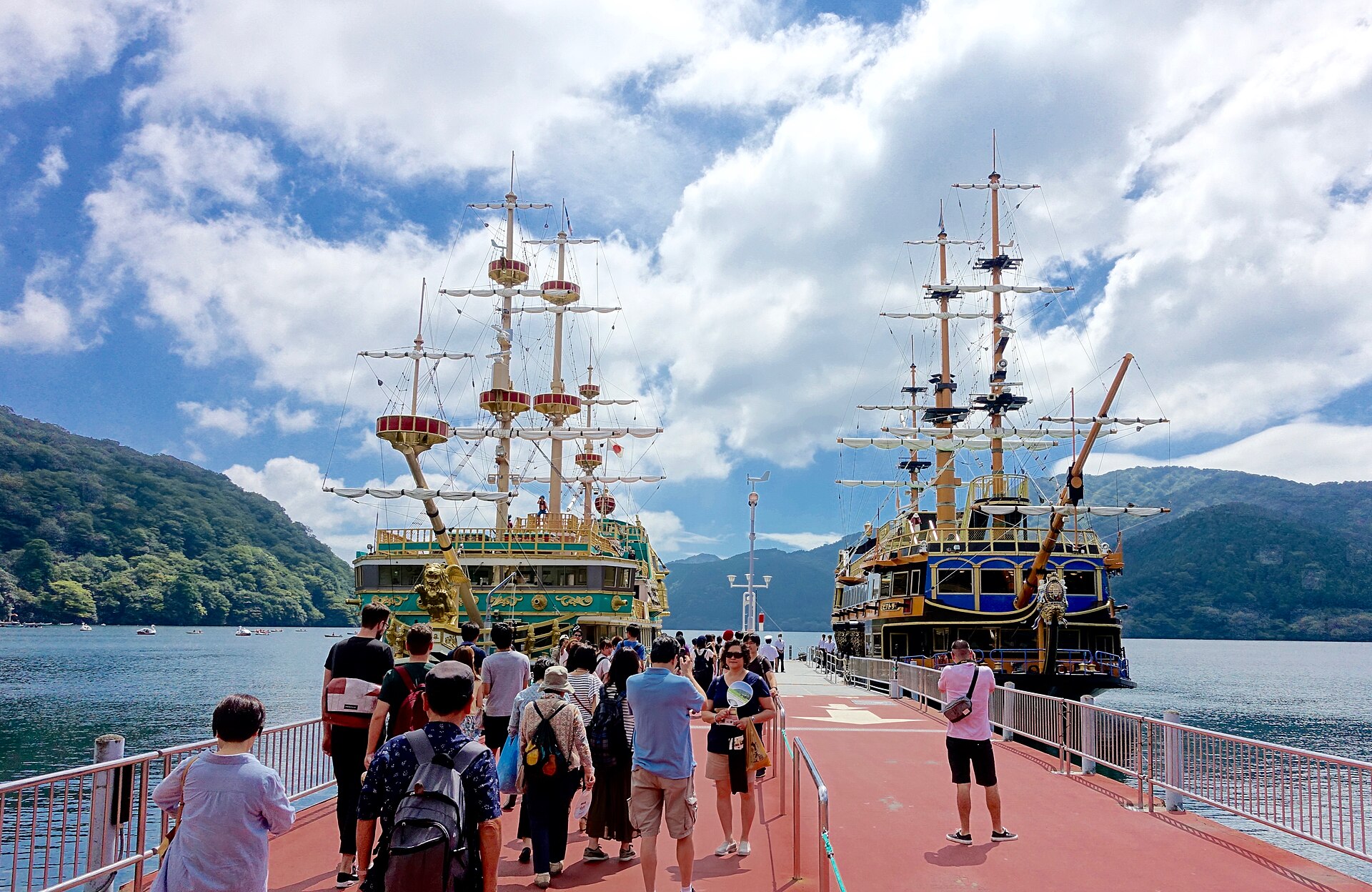
Ride on from Owakudani, changing gondolas at the station, down the long descent to Togendai on the shore of Lake Ashi. The lake is a caldera lake, formed when the same volcanic system dammed the valley thousands of years ago, and the crossing to Moto Hakone or Hakone machi takes about 25 to 40 minutes on the sightseeing ships, the famous pirate ships, all bright paintwork and tall masts. From the deck, on the clear days this guide has already been honest about, Fuji stands over the far shore, and the red torii gate of Hakone Shrine stands in the water near Moto Hakone, where most people leave the ship. Walk the few minutes into the cedars to the shrine itself if the queue for the gate photograph is long; the shrine is older, quieter and better. From Moto Hakone, the bus climbs back over the ridge and down to Hakone Yumoto, closing the circle, and the Romancecar does the rest. You will be in Shinjuku by dinner unless, as often happens, Hakone Yumoto's onsen and shopping street persuade you otherwise.
Making a day of it, and the case for a night
A good loop day starts earlier than feels reasonable: out of Shinjuku by about 8am, on the mountain railway before the tour groups reach Gora, at Owakudani late morning, on the lake in the early afternoon, and back in Tokyo by early evening. Trying to add the Open Air Museum at full length, a long lunch and a shrine as well turns the day into a queue management exercise, so choose two of the three. And know the alternative shape, because Hakone rewards it more than most day trips do: stay a night in a ryokan in Yumoto or Gora, soak in a real onsen in the evening, and take the loop the next morning from halfway round. An overnight stay roughly doubles your mornings, and mornings, as the Fuji section above explained, are when the mountain and the empty ropeway both happen.
Sleep in Tokyo for the day trip version, in Shinjuku if the early Romancecar matters most, which it does, or near Tokyo Station if Hakone is one day trip among several.
Stay in Tokyovia Trip.com · affiliate link
Our Hakone attractions page carries the loop's stops one by one, from the Open Air Museum to the shrine, and the Tokyo section of Japan What's On tracks the season around it. One pass, five kinds of vehicle, one volcano, one lake. Tokyo day trips do not get better engineered than this.
More reading on the articles page, or go straight to the events calendar.
Noteworthy events direct to your inbox.
Get what’s noteworthy for the weekend and beyond every Wednesday in your inbox.