
Guides · Wed 25 Nov 2026
Eating Osaka: the street food neighbourhoods, worked properly
Osaka does not have a food scene, it has food neighbourhoods, each with its own dish, its own hours and its own rules. Dotonbori for the griddles, Shinsekai for the skewers, Kuromon for the morning market, and the lanes in between: a worked route through the city that invented eating until you drop, dish by dish and rule by rule.
Osaka has a word for its relationship with food: kuidaore, eat until you drop, or more precisely eat until you ruin yourself. It is printed on the merchandise and it is also, unusually for a slogan, simply true. This is a merchant city that has fed itself enthusiastically for four centuries, and it organises that enthusiasm by neighbourhood. The mistake visitors make is to treat Osaka food as a list of dishes to be collected anywhere. The dishes belong to places: takoyaki belongs to the Dotonbori griddles, kushikatsu belongs to Shinsekai under the tower, the morning market food belongs to Kuromon, and each place has its hours, its etiquette and its way of being done properly. This guide works the neighbourhoods in the order of a day, morning market to midnight lane, with the rules stated where they apply, because in Osaka the rules are half the flavour.
Morning: Kuromon Market, the city's kitchen
Start where Osaka's chefs start. Kuromon Ichiba, the market arcade east of Namba, runs to about 150 shops under its covered street: fishmongers, greengrocers, butchers, pickle sellers and knife shops, in a market that exists first to supply the city's restaurants and second, happily, to feed the people walking through it. The way to work Kuromon is tabe aruki, eating as you walk, in small amounts from many stalls: a skewer of grilled seafood from the fishmonger who just cooked it, a cup of cut fruit, a piece of tamagoyaki still warm, a single oyster, a small bowl of sea urchin if the morning and the budget both allow. Go before ten for the market at work rather than at leisure, buy small and often, and keep moving with the flow of the arcade rather than camping in front of a stall with a suitcase. Kuromon is a working market that welcomes grazers, and the respect it asks is simple: eat what you buy near the shop you bought it from, and take your rubbish back to that shop.
Midday to evening: Dotonbori, the griddle district
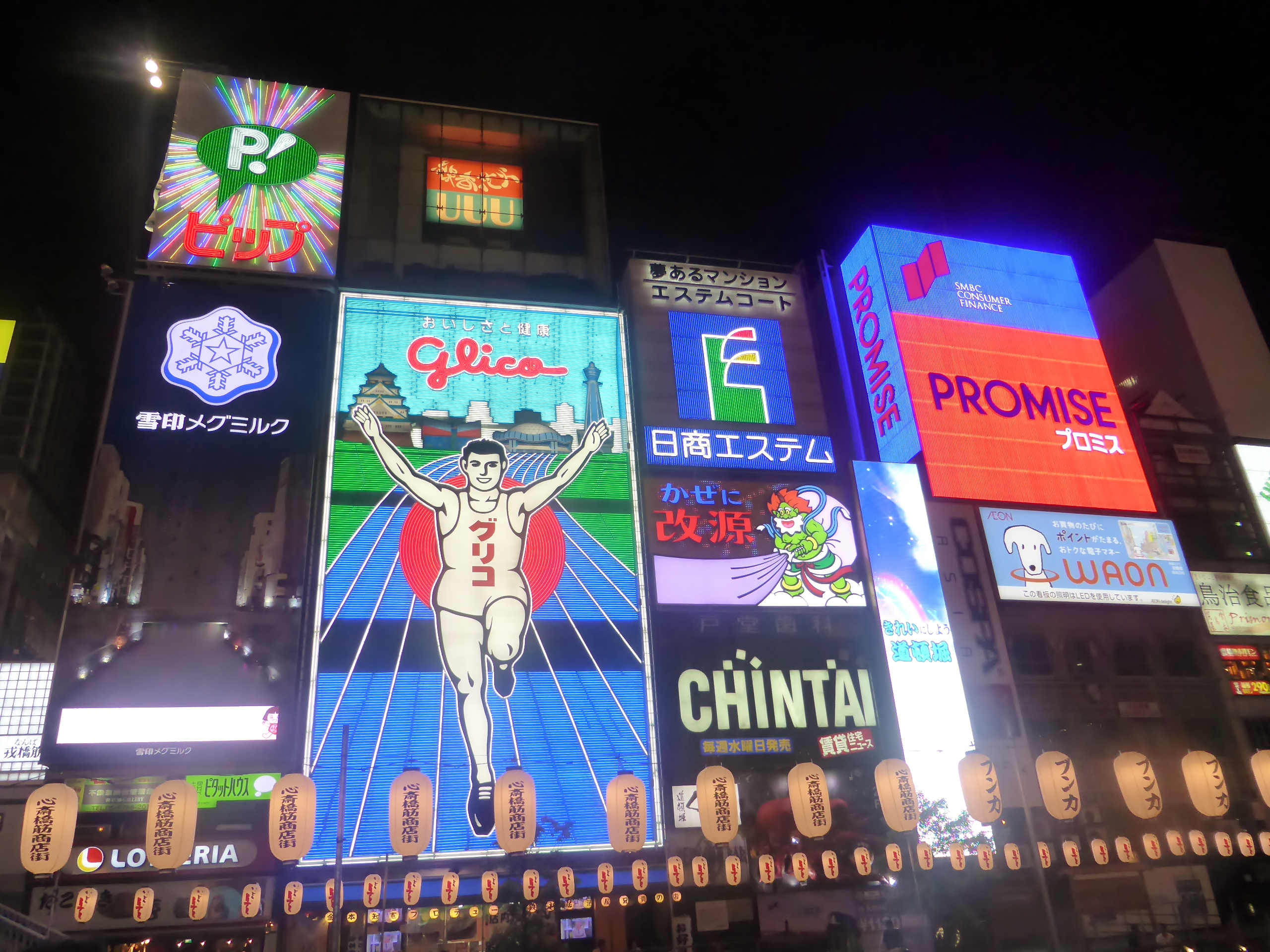
From Kuromon it is a few minutes' walk north to the canal, and the city's theatre of food. Dotonbori, the restaurant and entertainment strip along the Dotonbori canal, grew up feeding theatre crowds in the Edo period and has never stopped: the giant signs, the mechanical crab, the Glico running man over Ebisubashi bridge, and below them a solid wall of griddles. This is flour food country, konamon, the wheat based cooking Osaka claims as its soul. Takoyaki first: balls of batter with octopus at the centre, turned in dimpled iron plates until the outside crisps and the inside stays molten, dressed with sauce, mayonnaise, bonito flakes that wave in the heat and a dusting of aonori. Two rules. They are served at a temperature that punishes impatience, so break the first one open and wait, and the stall with the queue of locals is making them to order, which is the only way they should be eaten.
Okonomiyaki is the district's sit down dish, and Osaka style is the original: cabbage, batter and your chosen fillings mixed together and grilled as one thick pancake, finished with sauce, mayonnaise and flakes at the table. It is a meal, not a snack, and it anchors the Dotonbori evening. Around those two pillars the canal fills in the rest: ikayaki, whole squid pressed flat in a hot iron and cut into strips; ramen counters; gyoza; and 551 Horai's pork buns, carried home in steaming red boxes by half the city. The side lane that rewards finding is Hozenji Yokocho, two stone paved alleys about eighty metres long behind the noise, lined with small restaurants and bars around the moss covered Fudo statue at Hozenji temple, where locals splash water on the statue for luck and then go to dinner. Dotonbori shouts. Hozenji, thirty seconds away, murmurs, and a good Osaka evening uses both.
Night: Shinsekai and the skewer rules
Ride south for the last act. Shinsekai, the retro entertainment quarter built around the Tsutenkaku tower, is the home of kushikatsu: skewers of meat, seafood and vegetables, crumbed and deep fried to order, eaten standing or shoulder to shoulder at counters that have done nothing else for decades. This is Osaka's most rule bound dish and the rules are the ritual. The skewer is dipped once in the shared pot of thin, tangy sauce before the first bite. No double dipping, ever: the pot is communal and the rule is absolute, printed on signs in several languages and enforced by the room. If you want more sauce after biting, use the cabbage leaf on your plate as the spoon, which is what it is there for alongside being the palate cleanser. Order in rounds, drink something cold, and let the skewers arrive in waves; beef, pork, lotus root, quail egg, prawn, cheese, and the seasonal oddities the counter suggests. Shinsekai at night, tower lit, arcades buzzing, skewers coming off the fryer, is the Osaka that Osakans themselves describe when they are being honest about loving the place.
The guided version of this quarter is genuinely worth it for a first night: a local led food tour through Shinsekai's backstreet eateries covers five places and fifteen dishes in an evening, including the stalls a visitor would walk past, and teaches the rules at the table rather than from a page.
Book the Shinsekai food tourvia Viator · affiliate link
The other two names to know: Tenma and Ura Namba
Two more neighbourhoods complete the working map. Tenma, in the north around Tenjinbashisuji, one of Japan's longest shopping arcades, is where Osaka eats on weekdays: standing bars, sushi counters, grills and noodle shops priced for regulars, with the shrine of Tenmangu at its heart. It is the least tourist facing of the food quarters and the most rewarding for a second trip or a long stay. Ura Namba, the backstreets behind Namba's main drags, is the drinkers' quarter: alleys of tiny izakaya and standing bars where the food is ordered in small plates all evening and the correct strategy is two dishes per bar and three bars per night. Between them, Tenma and Ura Namba are the answer to the traveller who has done Dotonbori and asks what else there is. The answer is most of it.
How to pace an eating day, and the small print
The craft of an Osaka eating day is portion discipline. Every dish in this guide is sold in a size designed for grazing, and the system only works if you respect it: one skewer round is not a meal, one takoyaki boat is not lunch, and the visitor who sits down to a full okonomiyaki at noon has spent the appetite the evening needed. Eat standing where the locals stand, share everything that can be shared, and let each quarter's dish be a course in a meal that lasts all day. Practicalities are few and worth stating. Many of the best counters and stalls are cash businesses or cash first, so carry yen in small denominations. The famous places queue at famous times; the same griddle an hour earlier or later usually does not. And Osaka portions its welcome generously but its seating tightly, so eat, enjoy, pay and move, and the next party gets the counter you just warmed. That rhythm, brisk and friendly, is the city's table manners, and following it is most of eating Osaka properly.
Making the pass pay, and the base
An eating day in Osaka is also a transport day, hopping between quarters, and the Osaka Amazing Pass is built for exactly this shape: unlimited Osaka Metro, city bus and the city's private railway lines within the city, plus entry to about forty attractions, in one day and two day versions. Priced against a day of metro hops between Kuromon, Dotonbori, Shinsekai and Tenma plus one paid attraction, it earns its keep; priced against a day spent entirely in one quarter, it does not, and the honest traveller does the arithmetic by their own itinerary.
Book the Osaka Amazing Passvia Klook · affiliate link
Base in Minami, the southern centre around Namba and Shinsaibashi, and three of the five quarters in this guide are walkable from your door, with Tenma a short metro ride north.
Stay in Osakavia Trip.com · affiliate link
Kuromon in the morning, the canal at dusk, skewers under the tower at night, and the standing bars whenever you are ready for them. That is Osaka eaten properly. Our events calendar carries the city's food festivals and market events through the year.
---
More reading on the articles page, or go straight to the events calendar.
Noteworthy events direct to your inbox.
Get what’s noteworthy for the weekend and beyond every Wednesday in your inbox.