
Guides · Tue 03 Nov 2026
Christmas and New Year in Japan: the complete guide
One guide to the whole season, from the first illuminations in November to the snow festivals of February: the lights and markets, Christmas Eve done the Japanese way, the New Year shutdown and the shrine mornings, and where the snow takes over.
Japan's festive season is really two festivals sharing one calendar. Christmas belongs to the cities: illuminations, German-style markets, fried chicken and cake, and a Christmas Eve that works like a second Valentine's Day. New Year belongs to the country: the great shutdown of 29 December to 3 January, temple bells at midnight, the first shrine visit of the year, and then, as January turns into February, the snow festivals of the north. This guide runs the whole season in order, with the dates that matter for 2026-27 and links to our full listings for everything named.
What you need to know, in short: 25 December is a normal working day in Japan, so Christmas is a season of evenings rather than a holiday. The lights switch on from early November, most shopping district displays end on Christmas Day itself, and the big garden and park displays run on into January and February. New Year is the opposite: one national holiday, 1 January, wrapped in six days of closures, the busiest shrine mornings of the year and the heaviest travel days on the rail calendar. Book the moving parts, the trains, the countdown tickets, the fried chicken, before the middle of December.
The lights: the season opens in November
The illumination season is the largest single theme of the Japanese winter. Our calendar counts 56 illumination events between November and February, and our winter illuminations guide covers them city by city. The shape of the season: the destination displays open first, in October, most city displays start during November, and the ones tied to Christmas switch off on 25 December, while the parks and gardens burn on into the new year.
In Tokyo, start with the free street lighting. The Keyakizaka slope at Roppongi Hills carries about 970,000 white and blue LEDs with Tokyo Tower closing the view, from 5 November to 25 December. Marunouchi Illumination lights about 1.2 kilometres of Naka-dori in champagne gold from 12 November to 14 February, and Shinjuku Minamillumi spreads about 275,000 LEDs across six venues around Shinjuku Station's south side from 11 November to 14 February. Hibiya Magic Time Illumination runs to the latest date of the central displays, 12 November to 28 February, lit every evening from 4pm.
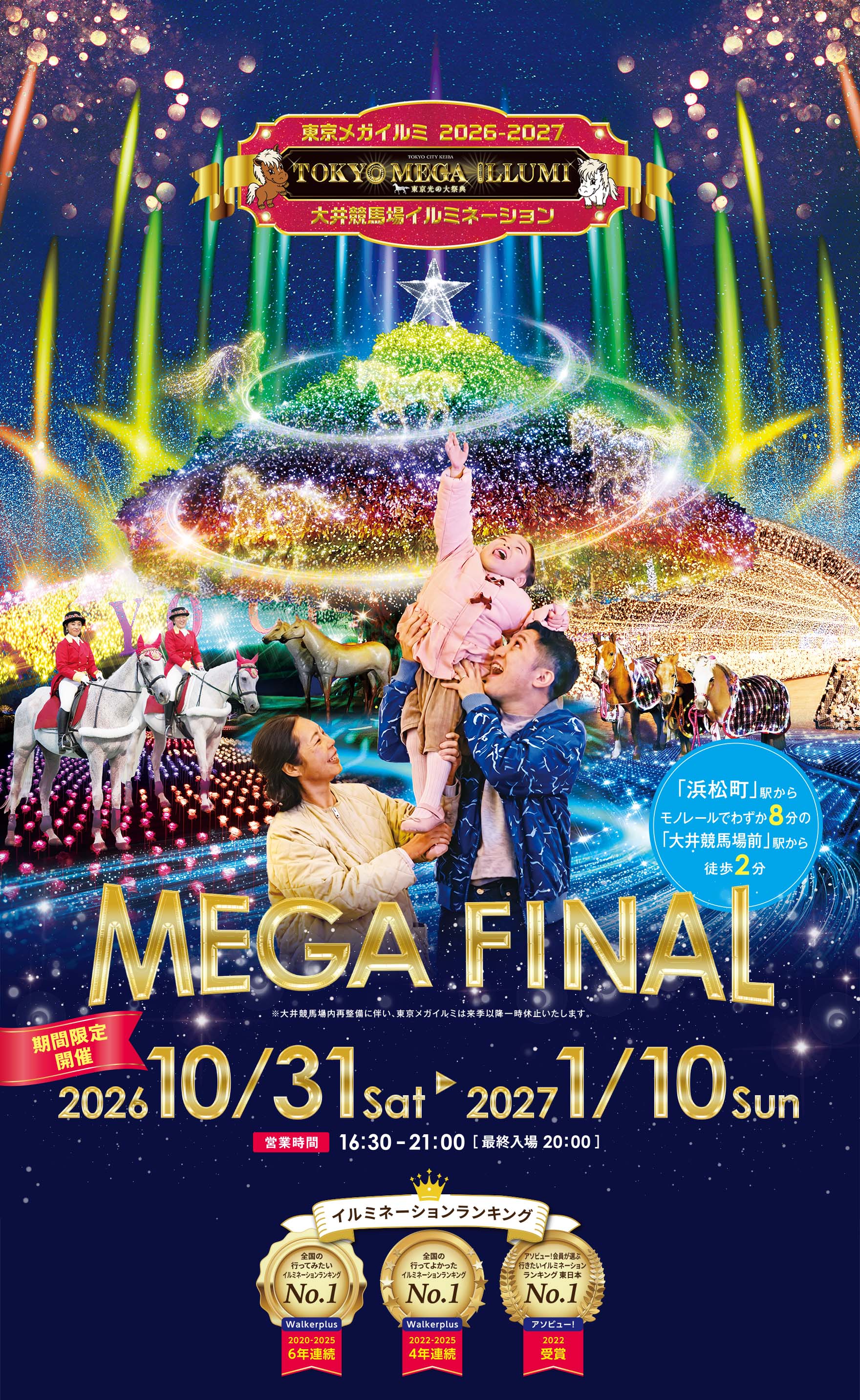
The one with a deadline is Tokyo Mega Illumi at Oi Racecourse. The operator has announced that this winter, 31 October to 10 January, is the display's final season before the site is redeveloped. It runs on non-racing days only, so check the operating calendar on our listing before you go, and go this year or not at all.
Beyond Tokyo, the two displays people cross the country for are Nabana no Sato in Mie, a themed landscape of light with a 200 metre tunnel, running the longest season of all, 17 October to 31 May, and the Ashikaga Flower Park display in Tochigi, more than five million bulbs over the wisteria park, 17 October to 14 February. Both are ticketed, and the Christmas dates at Nabana no Sato need special advance tickets. In the north, the Sapporo White Illumination runs from 20 November to 14 March across the city centre, with the Odori Park site ending on 25 December. Sendai's Pageant of Starlight is the short, intense one: about 480,000 bulbs in the zelkova avenue for 24 nights only, 4 to 27 December.
Places to stay in Tokyovia Trip.com · affiliate link
The markets
The German-style Christmas market is the season's set piece, and our Christmas in Japan guide tells its story in full. The original is the Munich Christmas Market in Sapporo, in Odori Park from 20 November to 25 December, a gift of the sister-city relationship with Munich and now in its 25th edition. It shares the park with the White Illumination, which starts the same day, so one Sapporo evening covers both. Fukuoka runs its market in the JR Hakata Station plaza from 7 November to 25 December, under the plaza illuminations.
Tokyo's biggest market changes address this year, and it is the detail most likely to catch people out. The Tokyo Christmas Market is not at Meiji Jingu Gaien in 2026. It runs at a new venue in Shin-Toyosu from 20 November to 25 December, with a second site at Shiba Park, by Onarimon Station, from 4 to 25 December. Entry is ¥1,000 (about US$6) on weekdays and ¥1,500 (about US$9) at weekends, rising to ¥2,000 (about US$13) on 24 and 25 December, and advance tickets are the sensible way in on the busy days. Yokohama's Christmas Market at the Red Brick Warehouse runs from 20 November to 25 December, entry ¥500 (about US$3), and books out on December weekends. Smaller markets run at Roppongi Hills and Azabudai Hills from 21 November, and at Tokyo Skytree Town from 5 November, all to 25 December.
Christmas Eve, the Japanese way
Christmas Eve, not Christmas Day, is the night. It is the most romantic evening of the Japanese year: couples book the illumination-lit restaurants weeks ahead, and the standard dinner is the one Japan invented for itself in the 1970s, fried chicken followed by a strawberry Christmas cake. KFC's Christmas buckets are reserved like restaurant tables and collected from queues on 23 and 24 December; every convenience store and department store food hall runs its own version of the same order-ahead ritual. Joining in, bucket and cake and all, is the correct way for a visitor to spend the 24th. What you cannot do is improvise it on the day.
If Christmas Eve has a soundtrack, it is classical. Bach Collegium Japan performs the complete Messiah at Suntory Hall on 24 December, as it has every year since 2001, and December's other fixture is Beethoven's Ninth, the Daiku, played all over the country as a year-end ritual. Book either the way you would book Christmas Eve dinner: early. The details sit in our Christmas in Japan guide.
The season's single most distinctive sight is in Hokkaido. For the Hakodate Christmas Fantasy, 1 to 25 December, a giant Christmas tree, a gift from Hakodate's Canadian sister city, Halifax, floats on the water in front of the red brick warehouses. It is lit every evening at 18:00 in a small ceremony with fireworks, a soup bar of local restaurants sets up along the waterfront, and the bay area is the place to stay. It is free, and it is ten minutes on foot from JR Hakodate Station.
The turn of the year: Countdown and the bells
For a loud New Year, the fixed point is Countdown Japan 26/27, the country's biggest year-end rock festival, at Makuhari Messe in Chiba from 26 to 31 December, with the countdown inside the hall at midnight on the final night. Tickets sell through the festival's official channels and the big acts' days go first.
The traditional midnight is quieter and stranger. On 31 December, omisoka, temple bells across Japan are rung 108 times, joya no kane, one strike for each of the earthly desires said to trouble human beings, rung out with the old year. The famous bells, at Zojoji in Tokyo and Chion-in in Kyoto, draw crowds who come to watch; at smaller neighbourhood temples the queue often gets to strike the bell itself. Afterwards the shrines open for the first visit of the year, and several major train lines run through the night for the crowds. Which lines do it this year is announced each December, so check before you plan around a late train.
Places to stay in Kyotovia Trip.com · affiliate link
Hatsumode: the first shrine visit
Hatsumode, the first shrine or temple visit of the year, is mostly done between midnight on the 31st and 3 January, and the scale at the top end is hard to overstate. The Japan National Tourism Organization puts Meiji Jingu in Tokyo at about three million visitors across the first days, and Naritasan Shinsho-ji in Chiba draws a similar number. Kyoto's Fushimi Inari, the mountain of ten thousand vermilion gates, is the pick for anyone starting a business or a venture in 2027. Senso-ji in Asakusa pairs the visit with the Nakamise shopping street in full festival mode, and Tsurugaoka Hachimangu in Kamakura gives you the shrine and a seaside town in one trip.
The practicalities are simple. Carry small coins: the classic offering is a five yen coin, go-en, a pun on good fortune. Buy an omikuji fortune, tie the bad ones to the racks provided and leave them behind, that is the point of them. Expect amazake, sweet sake, stalls and crowds moving at a shuffle. And know the trick that makes the whole thing pleasant: the crush is at midnight and on New Year's Day itself. Go early on the morning of the 2nd or 3rd, or late in the evening, and the same shrines are busy but human.
The other dawn ritual is hatsuhinode, the first sunrise. Tokyo sees it just before 7am on 1 January. The classic spots are the beaches and headlands of Chiba, above all Inubosaki in Choshi, which bills itself as one of the first places in Japan to see the New Year sun, Mount Takao, which pairs the sunrise with a hatsumode at Yakuoin temple on the summit, and Enoshima, looking back across the bay. In the city, the observation decks run ticketed first-sunrise openings that sell out in December; Tokyo Skytree's Tembo Deck, 350 metres up with Mount Fuji on clear mornings, is the grandest of them, and its ordinary timed tickets are bookable ahead.
Book Tokyo Skytree ticketsvia Klook · affiliate link
What closes, and when
New Year is Japan's real shutdown, and our New Year in Japan guide carries the full day-by-day account. The short version: government offices close from Tuesday 29 December to Sunday 3 January; bank counters close from 31 December to 3 January, although convenience store and station ATMs keep running; most museums and galleries close for a stretch somewhere across the same window, each on its own dates; small family-run restaurants commonly shut for several days, while chains and hotel restaurants trade on shortened hours. Shrines, temples, convenience stores and the big city shops stay open, and from 2 January the department stores reopen with the first sales of the year and the fukubukuro lucky bags.
The travel days matter as much as the closures. JR's fare calendar marks 29 and 30 December as peak days for the outbound rush, and 2 and 3 January for the return. On peak days the reserved seats on the shinkansen go early and some trains run reserved-only. If your trip crosses the turn of the year, the trains and the hotels are the two bookings to make in November, not December.
Into the snow: January and February
The season does not end at New Year; it changes element. On four January nights, the 11th, 17th, 24th and 31st, the thatched village of Shirakawa-go lights up under snow. The light-up is fully reservation-only, with no walk-up access, and the January dates are the hardest ticket of the Japanese winter. Late January brings the Kobe Luminarie, 29 January to 7 February, the memorial display first lit in 1995 for the victims of the Great Hanshin-Awaji Earthquake, and unlike the Christmas lights it has a reason to exist that has nothing to do with shopping.
Then February belongs to Hokkaido. The 77th Sapporo Snow Festival runs from Thursday 4 to Thursday 11 February 2027 across three sites, the Odori Park snow sculptures, the Susukino ice sculptures and the Tsudome snow park, all free. The final day, 11 February, is a national holiday, and Sapporo hotel prices in festival week are the peak of the Japanese winter, so the room is a November decision too. Forty minutes away by train, the Otaru Snow Light Path lines the canal with snow lanterns from 6 to 13 February, and the two pair into one trip. Further south, Yokote in Akita builds its kamakura snow huts on 15 and 16 February, as it does every year, and the snow monsters of Zao, trees turned to ice sculptures by the Siberian wind, are at their best through February.
Places to stay in Sapporovia Trip.com · affiliate link
Planning the season
The season rewards a simple order of operations. In November: book New Year trains and any hotel nights between 29 December and 3 January, Snow Festival rooms in Sapporo, and Countdown Japan tickets. In early December: reserve the Christmas Eve chicken and cake, the Messiah or the Ninth, and Mega Illumi while it still exists. Then leave the rest loose. The illuminations are mostly free, the markets mostly walk-up, and the shrines charge nothing at all. Japan does the festive season properly and, Christmas Eve dinner aside, remarkably cheaply. The only real mistake is arriving on 29 December with nothing booked and a list of small restaurants to try.
Prices and dates checked against organisers' published information on 3 November 2026. Illumination operating days and market entry arrangements can change with weather and crowds; confirm on the listing page before you travel. Photo: Tokyo Mega Illumi, official site.
More reading on the articles page, or go straight to the events calendar.